Thursday, November 19, 2009

China and expansion

Did I already mention that China is a big place? With a whole lotta people in it?

The country is opening up in a lot of ways -social, economic, science, and there is a growing group of people that can afford wine, but they haven't necessarily had it before. There are also a relatively high number of rich, who can afford very expensive (and usually French) wine, but of most interest to the domestic wine industry are those that are doing well, but not well enough to be called rich. You know, like the middle-class.

They know something about wine, probably on the order of, that it's something that rich people and foreigners drink, and that piques their interest enough to try it, or they might want to emulate the rich to climb the social ladder (what silly games we people play sometimes! :-)

So even though a small percent of people with the income buy wine, and only a fraction of those buy wine very often, because the absolute numbers are so big, it equates to a heap of wine being consumed domestically.

So, I've mentioned what they're doing on the vineyard side of things - planting large areas of grapes, but to accommodate those grapes, you need wineries to process them and make them into wine!

So I visited a few wineries there as well. The largest and most impressive was a brand new facility built by Chang Yu to service the large area of vineyards they had planted in the Yinchuan area. The finishing touches on the place were being done when we went through, and it was impressive to see a 20,000 tonne winery being put up, just like that!

Red wine tanks lined up all in a row.

Row upon row of tanks, one section devoted to whites, and the rest to reds (more reds than whites are made, by a large margin). The tanks for the latter had motorised stirrers built into the bottom to aid with extraction, and all had a chute by the door that the must could be pushed out and onto a conveyor which augers the skins and seeds to the presses.

The auger system they put in place to ferry the red must to the presses after fermentation. Keeping this clean will be a challenge!

Sorry, no two-tonne open-top fermenters here!!

While I've seen bigger wineries, I haven't seen one of this size going into a completely new viticultural region. Obviously, the company has big plans for wine from there!

The new Chang Yu Visitors Centre in Yinchuan -this building is dwarfed by the winery! When they do things, they do them big!


Tuesday, November 10, 2009

China -viticulture to the west

In this installment, I'm going to describe a few things that I saw in the Ningxia province, near its capital city, Yinchuan.

Yinchuan is known as a rural city, it having a population of "only" around one million people. It is an extremely spread out city, with incredibly straight roads that go long distances. One road runs for 40km through the city and is dead straight all the way!

The areas near Yinchuan are viticulture growth areas, as the climate there is thought to be well suited to wine production. The history goes back a bit, with a 1984 wine being recognised as the first white wine made in Ningxia. There are some good reasons to have grapes growing here - supposedly it has the second highest number of sunshine hours per year, second only to Tibet, which is probably a bit too harsh of an area! However, the same drawback are here - it's so cold and dry during the winter that the vines must be buried each autumn. A major headache, even in this land of plentiful labour.

Rainfall is only 200mm per year, but it can occur pretty much all at once! The wettest months on average are July through December, so right during the grape ripening season!

The soils are very sandy, so phylloxera is not yet a problem (it has been found in the Shandong province and in the areas around Beijing), and thus most vines are own-rooted, propagated by cuttings taken from another vineyard (which has meant the spread of virus has been wide and far!). Soil pH can be very high before amendment - 8.9!!
The soil in a vineyard near Yinchuan - pure sand!


I was told that there are about 5000 hectares of grapes in Ningxia, and a good yield for the red varieties they like to grow is in the range of 22 tonnes per hectare, which is very high!! Although the rows are reasonably far apart, the between vine spacing is very close.
Vines in the Chateau Helan vineyard, with the Helan Mountains in the background. Vines are very closely spaced, with the vertical trunks being laid down along the row in the Autumn, before being covered with soil.

All in all, a very different area to grow grapes!!

Tuesday, October 27, 2009

China -the first days

Just to join those that say you can't go to China on a business trip and not take in some of the other great things to do there, here I go!

I got to China on a Tuesday afternoon, arriving at the gate on time at about 3:15pm. However, it was a long wait to get through immigration. The airport is astounding in its scope! The terminal I arrived in was built for the 2008 Olympics and accommodate the flocks of people attending the event, but I could not have prepared myself for the magnitude of its size. It is an impressive complex!

The next two days were a whirlwind of touristy visits, including the Great Wall, which is a marvel, but it's disappointing to know that the sections that most tourists see are reconstructed out of stone, when the originals were much different. As only relatively small sections have been done up for the tourists, there are still original remants that you can see. Although we didn't get to see any of these near Beijing, they are nearby. Still, the reconstructed wall is not to be missed. What I was impressed with was the steepness of sections of it. There was no giant earth moving machinery in those times, so wherever the ground was, the wall was built. Amazing to think of the amount of effort that went into it!

We also visited Tiananmen Square, the last day before it was closed to the public in preparation for the 60th anniversary celebrations, the Forbidden City, which is an immense site filled with more things to see than you could possibly fit into a single day, and the Summer Palace, which seemed appropriately palatial!

These sights, along with an impressive array of diverse foods, got us off to a rocking start!

Oh, and yes, we did actually view something grapevine-y! We were lucky enough to be able to visit Chateau Nubes, which is a winery yet to be opened, but is among quite a few start-ups (around 60) that are appearing in the area near Beijing/the Great Wall in order to capture some of the tourism market.
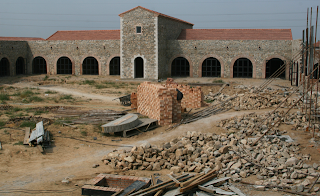
The courtyard of the unfinished winery. Underneath this area are the underground cellars.


No small outfit is this - the building is being made out of local stone, as per the native traditions of the area, and vast underground tunnels will hold the wine for ageing and various functions. The vineyards were young, and as the winters are harsh, with cold and wind-blown sand, all vines (own-rooted) are buried over the dormant season (more on this later!).
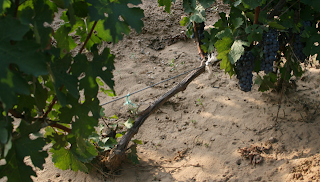
This is one of the three year old Cabernet Sauvignon vines in the vineyard. The irrigation water runs right under the vines. The main trunk is buried in the winter months. The cane to the left of the photo could be used as a replacement trunk.

The vineyards will eventually cover 50 hectares, but only 20 had been planted so far. Rainfall is only 200-400mm per year, so the vines are irrigated by furrow. The soil is basically sand (this was all desert, after all!) with a relatively thin layer of topsoil. Harvest of the approximately 6t/ha happens in mid-October, about the same time as the frosts arrive, funnily enough. All they had bearing at the time was Cabernet Sauvignon, which was in its third leaf this season.

Looking down the rows - note that the soil is hilled up in the centre - the soil that is used to cover the vines in the winter needs to go somewhere! This also limits the row spacing, as if it is too narrow, there isn't enough soil available to cover the vines!

One nice thing about the area is that at present, there is little problem with fungal disease, with copper sulfate for Downy Mildew control being used occasionally.

So on these first days we were exposed to the magnitude of China's largest city and its key tourist attractions, but also to the potential boom in wineries in the area around Beijing. The real estate agent's mantra, "location, location, location!" applies here as elsewhere - you need to be near the market! With lots of wineries popping up near Beijing, there are quite a few new businesses that are hoping tourist dollars (and curiously, the government, which buys a lot of wine to give as gifts) will help their wineries grow.

Saturday, October 17, 2009

Frost in the late throes of ripening

Just a quick note about late season frosts, while they're happening in Niagara. In New Zealand, early season frosts are a common problem, but not so much late season ones. I've already written about the use of wind machines in the dormant season (Aug14), but this season Niagara is in the situation of having many grapes (Chardonnay, Riesling, Cabernet franc, Syrah...) still out on the vines, and yet temperatures are dipping to below zero.

One reasonably strong frost event can kill all the green leaves on the vines, which means that the ripening process effectively stops (a small amount of sugar may accumulate in the berries due to the vines dipping into their carbohydrate reserves, which isn't good for long term vine health, sugar concentration may increase due to berry shrivelling, and then there may be small changes to acidity and flavour). Leaving the fruit on the vine won't help when you're trying to make normal table wines (icewines are a special case!), and if the vine tries to push a bit more sugar into the fruit using its reserves, it will be less resistant to cold temperatures during the winter, and may suffer a bit in the early season following.

So the fruit has to come off, ready or not!

To prevent the leaves from making an early departure, the wind machines can be used (providing there is an appropriate inversion layer) to keep the temperature dipping below zero, and keeping the leaves on the vines so they can photosythesise a bit more, hopefully ripening the fruit.

Even though the daytime temperatures are cool at best right not, there can be a significant amount of activity in the vines and fruit if it's sunny. The sun's radiation can heat fruit and the leaves to above the air temperature, so enzymes can be rockin' along quite nicely if it's not overcast or too windy.

Ironically, clear skies and lack of wind are exactly the kind of conditions under which frosts form, so what you want during the day isn't what you want and night!

We're keeping our finger's crossed for still air and sunshine during the day and clouds and a gentle breeze at night!!

Wednesday, October 14, 2009

China!

Well, there has been a delay since the last post, and there something of a passable reason for this! For about two weeks I was traveling through parts of China (my first visit there), doing some touristy things as well as some looking at vineyards and wineries.

To say that a visit to the country was an eye-opener would be a vast understatement! In fact, "vast" is a good term to use when talking about it, since it covers a huge geographical spread, as well as in reference to its population!

As some background to the trip, I was invited there by a visiting scientist, Changbing Song, who works at the Northern Nationals University in Yinchuan, Ningxia. This is about 1100km west-southwest of Beijing. Changbing visited me in New Zealand in 2008 to do some research, and kindly was able to bring me to China (with the assistance of the China Foreign Experts Bureau) to give a couple of seminars and view the industry there. In addition, some others sponsored my time in Beijing (Professor Changquing Duan of China Agricultural University) and in Yantai (Changyu Wine Group).

In addition, also invited on the tour was Wen-feng (Regon) Hung, who is a PhD candidate at Lincoln University, and who helped Changbing quite a bit while he was in New Zealand. As well, Regon's PhD research involves wine protein stabilisation, and he was to present his work on the tour as well.

It also helped me greatly in that since Regon was from Taiwan, he could speak the language, whereas I could only speak a few words! Though I am half-Chinese (with my Mom coming from the Sichuan Province), I never took an opportunity to learn the language. So I am deeply indebted to Regon for all his hard work in translating and looking after me!

So with that background, I can begin to relate my China trip experiences and observations... in the next post!! (sorry!)

Saturday, September 12, 2009

mmmm... beer!

Ok, yes, I'm a wine fan. I love trying out new and different wines! But hey, it's not the only fermented beverage worth looking at! :-)

They say that it takes a lot of beer to make good wine, so to help everyone make better wine, try this beauty, which I was served recently:

Innis & Gunn Original Oak Aged Beer

Talk about fusion of wine making and beer making! The oak lends a heartiness to the beer that is outstanding! Give it a try (as long as you're of legal drinking age, that is!! :-)

Monday, September 7, 2009

Blue is the colour of my true love's ... grapevine??

There are big differences between growing grapes here in Ontario versus good 'ol New Zealand. When you move from one place to another, sometimes they stick out like a sore thumb.

Case in point: Off-colour grapevines. Driving around Niagara you may come across vines looking like the picture on the right.

This rather sickly shade is from a copper and lime solution, called Bordeaux Mixture by some, that is applied to the vines to keep diseases at bay. For grapes, it is an effective control for Powdery Mildew and Downy Mildew, but it is used in a wide variety of crops for fungal and bacterial diseases. See this UC Davis page for more information.

The history around Bordeaux Mix is worthy of discussion, and was included in the book my Dad and I wrote (<shameless_plug> Grapes, published by CAB International, and available at a variety of bookstores, including Amazon.com </shameless_plug> ):

"Downey Mildew, imported with the American Grapevine material that was used to combat Phylloxera, was first reported in France in 1878 and caused another downturn in French grape production until a control method was found. The story goes that a grower just outside the village of Bordeaux was having trouble with townspeople stealing grapes as they walked by his vineyard (Prial, 1987). He decided to paint the clusters near the road with a greenish-blue paste made by mixing copper sulfate and lime, which gave the leaves and fruit and unappetizing splotchy green-blue colour. It is not reported if this deterred the pilfering, but a passing scientist observed that the grapes did not develop Downy Mildew. A few enquiries and experiments later, in 1885, he published resutls that showed the effectiveness of this bouilli bordelaise (Bordeaux mixture), and it is still used around the world for control of Downy Mildew as well as other disease organisms."

Bordeaux mix is approved for use in Organic and Biodynamic growing as well, and it is an important tool to being able to control Downy Mildew in particular in those systems, as Powdery Mildew can also be controlled with sulfur.

One issue with its use is that it does add copper to the soil, so with long term application (decades and decades) to the vines, the amount of copper in the soil can get too high, resulting in less productive vineyards. So like anything else, it must be used with intelligence and restraint.

Winegrowers are well aware of the challenges of using Bordeaux mixture and use it as only a part of a well-designed disease management programme.